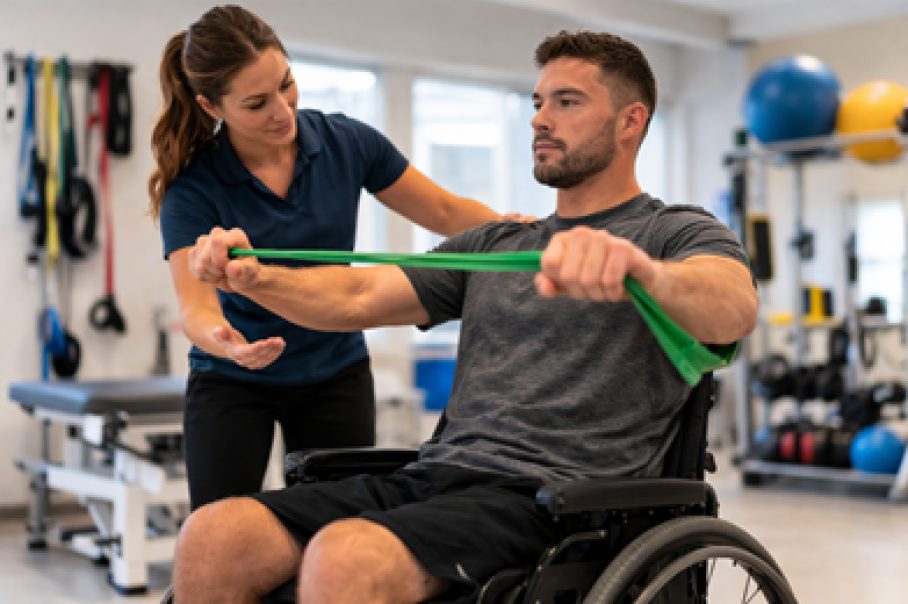
Upper extremity function stands as a key rehabilitation priority if you have spinal cord injury (SCI). Research shows that 30 to 60 percent of people with SCI develop shoulder problems. Carpal tunnel syndrome affects 40 to 66 percent of this group. People with tetraplegia consistently rank improving their upper limb capabilities as their top priority after injury.
Studies show strong links between upper extremity performance and independence in activities of daily living (ADL). The patient's grip strength and hand function play a crucial role, especially in feeding and dressing tasks. The treatment of tetraplegic affecting the upper limbs aims to maximize function so patients can perform daily tasks independently. This connection between upper extremity capability and everyday independence makes integrated rehabilitation essential.
This guide provides practical, evidence-based strategies to improve hand and upper extremity function after spinal cord injury. You'll learn about recovery factors and treatment options for cervical injuries like C4-C5, along with new interventions such as peripheral nerve transfers.
People with spinal cord injuries rank hand and upper extremity function as their top recovery priority. Yes, it is true, surveys reveal that patients value regaining arm function more than walking, bladder/bowel function, and sexual function combined [1]. This shows how crucial upper extremity function becomes in daily life after SCI.
Why upper limb function is critical for independence
A loss of upper extremity function creates one of the most devastating effects of SCI. It affects financial stability, mental health, and social connections. The statistics paint a stark picture, just 35% of Americans with SCI find employment after injury. Medical costs skyrocket, leading to a 33% increase in bankruptcy within five years [1]. Your ability to use your arms determines how well you can handle basic self-care and take part in community activities.
Upper extremity function associates strongly with quality of life measures. Research shows that good arm function helps SCI patients build social relationships and boosts mental wellbeing [1]. This explains why rehabilitation specialists work hard to preserve and boost any remaining upper limb capacity after injury.
Common challenges after cervical and thoracic SCI
SCI patients face many upper extremity challenges based on their injury level and severity. Upper limb pain affects 59% of people with tetraplegia, which often slows down rehabilitation [1]. Limited muscle pump activity from paralysis reduces blood and lymph flow. This creates swelling that limits motion and functional abilities.
Ongoing complications make it hard to maintain upper limb function:
Impact on ADLs like feeding, dressing, and mobility
Upper extremity function determines how independent you can be in daily activities. Studies show that self-care tasks, particularly feeding and dressing, associate most closely with upper extremity performance measures [2]. Movement time, smoothness, grip strength, and standard hand function tests show moderate links to independence in feeding, dressing, and bed/wheelchair mobility [3].
Cervical injuries make even simple self-care challenging. Patients with C4-C5 injuries often need adaptive equipment like universal cuffs or mobile arm supports for basic tasks. Good arm function helps with bed mobility and wheelchair transfers, key elements for staying independent.
Better upper extremity function creates positive changes across all areas of independence. This makes it an especially valuable recovery target for SCI patients.
When working with individuals with spinal cord injury (SCI), clinicians use standardized assessments to understand arm and hand function and monitor progress over time. These tools help guide rehabilitation strategies and evaluate meaningful functional change.
Assessments such as the Upper Extremity Functional Index (UEFI) and the Upper Extremity Functional Scale (UEFS) allow individuals to report how arm and hand limitations affect daily activities [7]. These self-reported measures provide insight into perceived function and real-world challenges. Both tools demonstrate strong reliability and validity in measuring upper extremity function over time.
SCI-specific tools like the Spinal Cord Independence Measure (SCIM-III) and ISCI-Hand focus more directly on independence and voluntary motor control of the upper limb [6]. SCIM-III evaluates self-care and mobility, and its self-care subscale correlates with upper limb performance measures [7]. ISCI-Hand examines voluntary motor control required for common arm and hand movements and relates well to objective movement measures [8] .
Performance-based tests are also commonly used. The Action Research Arm Test (ARAT) evaluates grasp, grip, pinch, and gross movement during functional tasks. The Box and Block Test (BBT) measures manual dexterity by timing how many blocks a person can transfer in one minute, demonstrating excellent reliability across trials [9]. Grip strength testing is frequently included as well, since it plays a critical role in daily function.
Together, assessments such as the UEFI, UEFS, SCIM-III, ISCI-Hand, ARAT, and BBT provide a comprehensive picture of upper extremity function, from strength and dexterity to independence in daily activities, helping clinicians tailor treatment and track meaningful functional gains over time.
Multiple strategic approaches must work together to help patients recover upper extremity function after SCI. These techniques aim to maximize neural recovery and help patients become more independent. Improving hand function after spinal cord injury requires a combination of early intervention, high-repetition training, and strategic use of assistive technology.
Occupational therapy and task-specific training
Task-specific training has become the lifeblood of rehabilitation. It uses repetitive practice of purposeful movements to encourage neuroplasticity. Patients need active voluntary muscle contractions specific to functional tasks. Research shows that hundreds or even thousands of daily repetitions are needed to improve [12]. Therapists work just like sports coaches. They analyze movement components and give concrete, task-oriented instructions. Research indicates that about 56 hours of task-specific training over 6 weeks leads to meaningful functional improvements [13].
Activity-Based Therapy (ABT) for neuroplasticity
ABT helps improve muscle function below the injury level instead of just compensating for paralysis. This method uses high-intensity, high-repetition functional activities to promote neural recovery. ABT protocols often use additional strategies like neuromuscular electrical stimulation or robotic devices to increase neuroplasticity [15]. These methods can lead to major functional improvements for individuals with incomplete SCI [14].
Strengthening and motor relearning techniques
Traditional strength training remains essential but needs adaptation based on remaining muscle function. Muscles with grade 3+ strength respond best to progressive resistance training with high loads and low repetitions [12]. Low-intensity blood flow restriction exercise has also shown promise. It improved forearm muscle strength in people with SCI after just 16 training sessions. This technique restricts blood flow at 60% of limb occlusion pressure while using weights at only 30% of maximum resistance [1].
Adaptive tools and assistive technology
Many individuals with cervical SCI seek ways to improve grip strength and functional hand use after SCI to support daily tasks such as eating, dressing, and wheelchair mobility. Assistive devices for tetraplegia hands range from adaptive utensils to powered grip assist systems designed to support functional grasp. Budget-friendly solutions include modified ergonomic equipment, universal cuffs, and self-fasteners that enable simple self-care activities [2], while more advanced technologies include smart home systems, voice recognition software, and specialized computer access devices [16]. Neuroprostheses have shown remarkable improvements in hand function. Studies report increased pinch force from 4N to 19N after implementation [17]. enable simple self-care activities.
Wearable assistive technologies such as Carbonhand can also support individuals with reduced grip strength by providing powered assistance to finger flexion during grasping tasks. Unlike fully implanted systems, wearable grip assist devices are externally applied and designed for use during everyday activities. They also differ from larger robotic exoskeleton systems typically used in clinical settings, as they are lightweight, portable, and intended for functional use during daily routines rather than isolated therapy sessions. By enhancing grip during activities like holding utensils, carrying objects, or stabilizing items, Carbonhand helps bridge the gap between available muscle function and real-world task demands, supporting greater independence while still encouraging active participation in movement.
These technologies serve three main goals: optimizing independence, reducing caregiver assistance, and enhancing quality of life [16].
Spinal cord injury recovery patterns differ vastly from person to person. Many factors determine how well someone recovers their ability to function. Learning about these factors helps create realistic goals and better rehabilitation plans.
Level of injury (e.g., C4 C5) and completeness
Spinal cord lesions' location and severity directly determine functional limitations. Patients with C5 injuries can still use their shoulder and elbow flexors but find it hard to extend their elbow against gravity [19]. Research shows that patients with low-level injuries score 6.6% higher on the Spinal Cord Independence Measure than those with high-level injuries [18].
The ASIA Impairment Scale classifies injury completeness, which substantially influences potential outcomes. Complete injuries, where there's no motor or sensory function at S4-S5, usually show limited recovery potential [20]. Incomplete injuries, however, show much better improvement with treatment [21].
Age, body composition, and comorbidities
Each additional year of age at the time of injury is associated with approximately 0.18% lower functional scores [18]. Younger patients recover better neurologically [22]. The body changes after injury, muscle mass decreases while fat tissue increases [23].
Other health conditions play a vital role in recovery. Patients who develop pressure sores score 9% lower on functional tests, while those with spasticity score 8% lower [18]. The body often develops metabolic changes, including lower HDL, problems with glucose tolerance, and insulin resistance [23].
Consistency and timing of therapy
Early rehabilitation leads to better outcomes. The most substantial neurological improvements happen in the first 3-6 months after injury (+12%), and recovery usually levels off around 9 months. This early period shows increased neuroplasticity, and the nervous system responds better to treatment [24].
Role of patient motivation and support systems
Motivation drives the recovery process. Studies of the nucleus accumbens, the brain's reward and motivation center, show its vital role in restoring hand control after SCI [3]. Psychological support becomes essential in the early stages of rehabilitation. Encouraging small, meaningful functional gains can reinforce effort, strengthen confidence, and help sustain long-term engagement in therapy.
Upper extremity function is the lifeblood of independence if you have spinal cord injuries. This piece explores how arm and hand capabilities affect quality of life, from simple self-care activities to community participation. The evidence shows that detailed assessment tools like SCIM-III and kinematic measures help clinicians understand functional abilities. Targeted rehabilitation approaches create pathways toward improvement.
Medical professionals need to consider the complex nature of recovery. Activity-Based Therapy stands out, especially because of its ability to apply neuroplasticity principles through high-intensity, repetitive movements. Task-specific training is a vital component that needs consistent implementation during the critical recovery window in the first 6-9 months after injury.
Several factors ultimately determine recovery outcomes. The injury's level and completeness create physiological boundaries, while age and health issues influence healing capacity. A patient's motivation, though less measurable, substantially affects involvement in rehabilitation and long-term success.
New adaptive technologies keep evolving and offer fresh possibilities for patients of all injury types. Simple adaptive tools and sophisticated neuroprostheses help bridge the gap between physical limitations and functional independence.
The path to improving hand function after spinal cord injury requires patience, persistence, and personalized rehabilitation strategies. The right assessment, targeted rehabilitation strategies, and attention to individual factors can maximize functional recovery. These elements then boost overall independence and life satisfaction for people living with spinal cord injuries.
This guide reveals evidence-based strategies to maximize upper extremity recovery after spinal cord injury, focusing on assessment tools, rehabilitation techniques, and factors that influence outcomes.
The key to successful upper extremity rehabilitation lies in combining early, intensive intervention with personalized approaches that consider individual injury characteristics and recovery factors. This comprehensive strategy maximizes the potential for regaining independence in daily activities.
[1] - https://pmc.ncbi.nlm.nih.gov/articles/PMC11439758/
[2]-https://www.heraldopenaccess.us/openaccess/low-tech-and-high-tech-assistive-tools-for-occupational-therapy-and-hand-rehabilitation-in-patients-with-upper-extremity-sensorimotor-impairment-and-disability
[3] - https://www.hardywolf.com/news/patient-motivation-key-for-spinal-cord-injury-recovery/
[4] - https://pmc.ncbi.nlm.nih.gov/articles/PMC4130402/
[5] - https://www.physio-pedia.com/Upper_Extremity_Functional_Index
[6]-https://www.jefferson.edu/academics/colleges-schools-institutes/rehabilitation-sciences/departments/outcomes-measurement/measures-assessments/spinal-corde-independence-measure-v3.html
[7] - https://pubmed.ncbi.nlm.nih.gov/36823179/
[8] - https://pmc.ncbi.nlm.nih.gov/articles/PMC8474732/
[9] - https://www.sralab.org/rehabilitation-measures/box-and-block-test
[10] - https://pmc.ncbi.nlm.nih.gov/articles/PMC8555709/
[11] - https://hal.science/hal-04616350/document
[12] - https://www.nature.com/articles/s41393-023-00911-4
[13] - https://pmc.ncbi.nlm.nih.gov/articles/PMC10345498/
[14]-https://www.bu.edu/drrk/research-syntheses/spinal-cord-injuries/activity-based-intervention/
[15] - https://pmc.ncbi.nlm.nih.gov/articles/PMC6037327/
[16] - https://asia-spinalinjury.org/wp-content/uploads/2023/03/Assistive-Technology-1.pdf
[17] - https://pmc.ncbi.nlm.nih.gov/articles/PMC9662059/
[18] - https://pmc.ncbi.nlm.nih.gov/articles/PMC6093142/
[19]-https://www.physio-pedia.com/Upper_Limb_Management_in_C4_and_C5_Spinal_Cord_Injury
[20] - https://www.travisroyfoundation.org/sci/resources/spinal-cord-injury-levels-classification/
[21] - https://www.tandfonline.com/doi/full/10.1080/10833196.2025.2528408
[22] - https://www.nature.com/articles/sc201390
[23] - https://pmc.ncbi.nlm.nih.gov/articles/PMC4509476/
[24] - https://link.springer.com/article/10.1186/s12883-024-03980-x